How often do your young learners study grammar? Always, often, sometimes, or never? Frequency adverbs are very common for talking about things like daily routines and how often we do certain actions. Our NEW Adverbs of Frequency lesson gives students ample speaking and writing practice with this grammar target! (more…)
time
Prepositions of Time
When is a good time to study prepositions? There are three main prepositions of time: at, in, and on. All three are thoroughly covered in our new grammar lesson on Prepositions of Time! (more…)
10 Ideas for Practicing Telling Time at Home
Practice Telling Time at Home
When it comes to learning about time and clocks, teachers can teach the basics in the classroom. However, the best way for kids to really practice is at home or when they’re on the go in the real world. Involve your kids whenever you’re consulting a clock and they will quickly learn to tell time naturally.
If English is your second language, make sure that you are saying times correctly. Review Tanya’s pronunciation tips, and practice the dialogues below.
Here are 10 ideas for practicing telling time at home. Each idea comes with a model dialogue with useful vocabulary and phrases for ESL parents. (more…)
Telling Time: Pronunciation
What time is it?
Everyone needs to know how to tell the time. Even if English language learners know how to express clock time in their native language, they might not be familiar or comfortable doing so in English. As a follow-up to our new, kid-friendly Telling Time lesson, I thought I’d record the pronunciation of the times in the lesson so that learners can clearly hear and practice how to express them. I hope this will make your students feel more confident the next time someone asks them, “What time is it?” (more…)
Telling Time
What time is it? Telling time is an important skill, and our new Word Bank lesson makes it easy to learn!
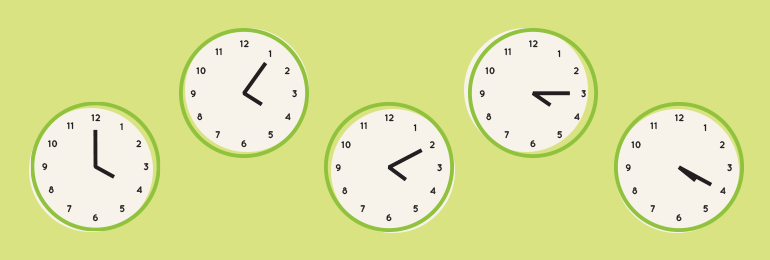
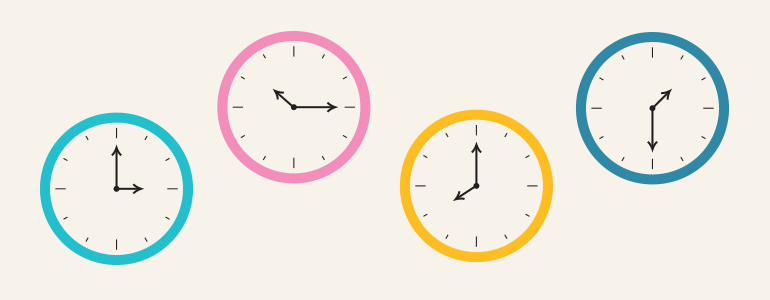
Our Telling Time lesson includes a picture dictionary with 13 common clock settings, a matchup, a word choice, and a spelling bee. We’ve made sure that this lesson includes the different, common ways of saying and writing the time (in numerical and alphabetical forms—e.g., 4:10, four ten, or ten after four). The variety and repetition of these exercises will ensure your young learners get plenty of practice without getting bored! Discussion questions at the end allow your students to practice talking about clock time in context. (more…)
Past Progressive Game for Young Learners: What Were You Doing?
This week in the Spotlight, we’re featuring a lesson from our Library on the Past Progressive. An easy way to start practicing the past progressive is with clock times. Kids love talking about themselves and their lives outside of the classroom. Try this activity after you’ve reviewed the structure of the past progressive.
Preparation: Print and Cut
Print this FREE 3-page PDF to use with the “What were you doing?” activities below.
Page 1: Print as many copies as you need of the Time of Day sheet. Cut the clocks out, and give each student one or more clocks to fill out. Have an envelope or container handy to put the clocks in after students write times on them.
Page 2: Print one page of Days of the Week strips for the class and cut them into strips. Place them in an envelope or container.
Page 3: Print one Day Planner page for each student for the Personal Assistants activity.