
Please see our updated post for Feb 14, 2016: Valentine’s Day Collection.
Please see our updated post for Feb 14, 2016: Valentine’s Day Collection.
“I have decided to stick with love. Hate is too great a burden to bear.”
—Martin Luther King Jr.
Students love learning idioms! With Valentine’s Day just around the corner, it’s the perfect time to teach love idioms to your young learners. Visuals like this poster can really help students remember idioms, which can be difficult because they don’t make literal sense. Last year, our writer Tara Benwell created this fun Love Idioms poster for us. Download the full-size PDF version by clicking on the image or link below.

Young learners will feel more confident in their English abilities when they learn how to introduce themselves properly. Our Spotlight lesson this week, Valentine – Simple Present Reading, provides a good example of how to introduce yourself in English.
(more…)

Are you a chocoloholic? Chocolate is now for sale in many stores in countries that celebrate Valentine’s Day. Your young learners will enjoy learning about where chocolate comes from and how hot chocolate became a popular drink!
Our Chocolate lesson in the Discovery Center includes discussion questions, pre-reading vocabulary, a short reading full of interesting facts, and comprehension questions. There are also engaging vocabulary review tasks in the form of a crossword puzzle, a word search, and a word maze!
Our Discovery Center has other fun food lessons too. We have lessons on cheese, ice cream, pizza, popcorn, and food allergies.

Most young learners groan at the mention of a writing task. Don’t worry—we have ways of making writing easier and more interesting for your students! First, teach your young learners our tips on how to write a paragraph. Next, try our writing activity, The Party, which guides students by starting the story for them. Soon your students will look forward to writing!
How will you correct their writing? Use our handy, free correction key to make your job easier. Our key has common codes to indicate spelling, grammar, and punctuation errors. Students can then try to correct their mistakes themselves—they seem to remember better this way. Students can also use this key for peer correction. (more…)
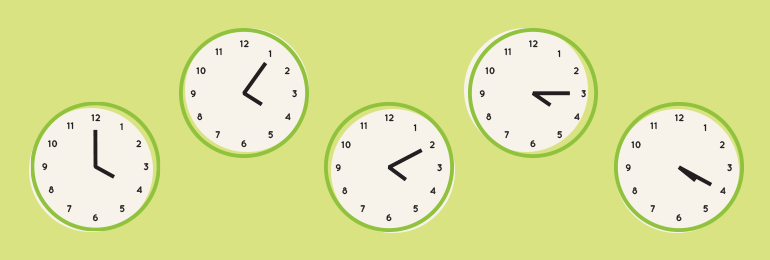
Everyone needs to know how to tell the time. Even if English language learners know how to express clock time in their native language, they might not be familiar or comfortable doing so in English. As a follow-up to our new, kid-friendly Telling Time lesson, I thought I’d record the pronunciation of the times in the lesson so that learners can clearly hear and practice how to express them. I hope this will make your students feel more confident the next time someone asks them, “What time is it?” (more…)

What time is it? Telling time is an important skill, and our new Word Bank lesson makes it easy to learn!
Our Telling Time lesson includes a picture dictionary with 13 common clock settings, a matchup, a word choice, and a spelling bee. We’ve made sure that this lesson includes the different, common ways of saying and writing the time (in numerical and alphabetical forms—e.g., 4:10, four ten, or ten after four). The variety and repetition of these exercises will ensure your young learners get plenty of practice without getting bored! Discussion questions at the end allow your students to practice talking about clock time in context. (more…)
When I introduce a gerunds and infinitives activity in class, I’m usually faced with looks of quiet desperation or grim determination. Most students find the endless list of verbs to memorize daunting, to say the least! Also, most textbooks don’t cover the fact that there ARE a few helpful rules for deciding whether to use a gerund or an infinitive in a sentence. The next time you’re doing gerunds and infinitives in class, try teaching the rules below—your students will thank you!
Gerund: VERB + -ING (eating, going, studying)
Infinitive: TO + BASE VERB (to eat, to go, to study) (more…)

Do your students like learning English? Do they like to study grammar? Gerunds and infinitives can be tricky for students to learn and remember! This week’s Spotlight lesson is Being Brave – Gerunds and Infinitives from our Grammar School section.
Students can practice gerunds and infinitives through a variety of tasks in this lesson. Activities include a pre-reading discussion, a short reading, comprehension questions, two grammar exercises, a writing exercise, and a fun word search.
The short story in this lesson is about bullying, a very important topic that should be discussed in class. (more…)
Though speaking quickly in another language can seem overwhelming at first, learning common language reductions (such as whacha, wanna, or gonna) can give students confidence in their speaking and listening abilities. My students always enjoy practicing reduced pronunciation—we’d have a lot of laughs together even when they’d get tongue-tied. Two things help learners feel more confident when practicing reduced pronunciation: guided practice with lots of modeling and handy tips to help them, and plenty of encouragement along the way. Remind students that even though reductions may sound like a whole other language at first, practicing reduced pronunciation means they’ll be able to better decipher quick, natural speaking when listening to native speakers, and they’ll sound more natural when speaking, too. (more…)
