Have you tried Sprout English’s NEW Simple Present Be Verb lesson plan? This new lesson is adorable, fun, and very useful for introducing the Be Verb to young beginners. After you use this lesson, you’ll need some fun games and activities to reinforce the language structure. Here’s one idea to try:
Be Yourself Game
1. Start by placing a word on the board that describes a few of the people in your class. For example: a nationality (African), gender (male, a boy), or age (10 years old). Tell your students to raise their hands if this word or phrase applies to them. Introduce one word at a time. Move on to appearances, personalities, and moods that can be used with the Be verb (e.g., brunette, blond, tall, short, smart, friendly, hungry).
2. Ask one student with a raised hand to make a sentence using the word on the board. For example: “African”.
Tomi: “I am African.”
Ask one student who doesn’t have a raised hand to make a negative sentence.
Andy: “I am not African.”
Ask one student to make a sentence using a contraction (negative or positive).
Fiona: “I’m African.”
Ask another student to form a question for another student.
Niko: “Are you African?”
3. After reviewing a few different words that can be used with the Be Verb (name, nationality, age, gender, appearance, personality, mood) hand out this PDF and ask students to fill in the blanks with words about themselves. They will fill in 7 positive and 7 negative sentences. Some sentences will have contractions. For example:
My name is Juan. My name is not Lizzie. I am Mexican (nationality). I am not Canadian. I’m 7 (age). I’m not 6. I am a boy (gender). I am not a girl. I am tall (appearance). I am not blond. I am happy (personality). I’m not shy.
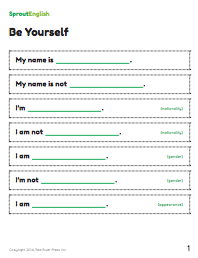
4. Have your students cut out their strips of paper. (no name attached) Collect all of the strips and place them in a container.
5. Mix up the strips and hand out 14 strips to each student.
6. Tell your students to sort their strips into statements that are true about themselves and statements that are not true about themselves.
7. Next, have your students pick up all of the strips that do not describe themselves. Your students will then mingle with their classmates to exchange strips. They should ask questions as they mingle (Don’t allow them to exchange strips without asking questions. If students are caught exchanging strips without communicating, you can take one of their correct strips and give them another incorrect one from someone else.) For example:
Anita has a strip that says, I am Algerian. She can walk up to Farid and say, “Are you Algerian?”
Farid will say, “Yes, I am Algerian.” Anita will give Farid the strip that says “I am Algerian.” Then Farid will ask Anita a question: “Are you eight years old?”
8. The first person to find three strips that describe himself can shout out “I am myself!” (The other students can continue mingling.) The teacher can check the winner’s strips by asking questions: Are you a girl? Are you Japanese? The student must answer appropriately.
9. As each student finishes, invite them to draw a self-portrait while they wait for their classmates to finish. Some students may need to give up strips that are true for other strips that are true, so that all students can finish. Or, you can end the game after the first few students finish.
Related
Find this week’s Spotlight lesson in the Grammar School – Basic Grammar Structures.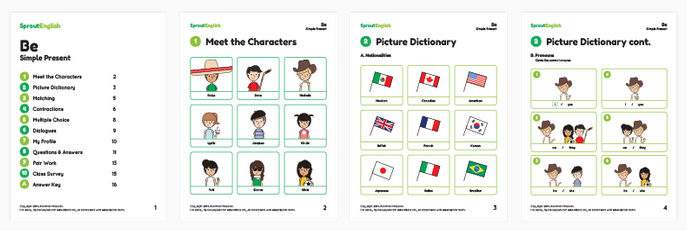


Purchase a subscription to access all our Young Learner resources. Only $7 a month.

