One of our subscribers recently asked me to blog about count and non-count nouns, and with our lesson of the week on food, I figured it was the perfect time to do so! Lower-level students need to learn about the differences in nouns fairly early on so that they can use plural forms and articles correctly. Non-count nouns aren’t so difficult for students if you present them in a certain way. Try the method below, and count on a good result!

1. WHAT ARE COUNT NOUNS?
In English, most nouns are count nouns (also known as countable nouns). They have this name because they can be counted. You can say one apple, two apples, three apples, etc.
Count nouns can be people, places, or things. When the count noun is singular, there is no -s ending, and we use an article like a, an, the, or one. When the count noun is plural, we add the ending -s, and we don’t have to use an article. However, the or a number higher than one is possible.
Examples of Singular Count Nouns:
- She has one brother and one sister.
- Do you have a pencil?
- I enjoyed the movie yesterday.
Examples of Plural Count Nouns:
- I have three dogs.
- He loves watching movies.
- The books are on the table.
Note: English has some words that don’t take -s. These words have irregular plural forms where the word changes in some way. Examples include child/children, tooth/teeth, mouse/mice, man/men, woman/women, and knife/knives.
2. WHAT ARE NON-COUNT NOUNS?
There are some nouns in English that can’t be counted. They are called non-count nouns (also known as uncountable or mass nouns). For example, you can’t say one rice, two rices, three rices, etc.
Non-count nouns almost never have an -s ending (some exceptions are news and certain school subjects like mathematics, physics, etc.). They never take the articles a, an, or numbers. However, they can take the.
Examples of Non-Count Nouns:
- I am eating rice.
- I don’t have time to talk right now.
- They love playing in the sand.
It is difficult for students to memorize every non-count noun in English, so telling them the categories or types of non-count nouns helps. Most non-count nouns can be grouped as food, liquids, feelings, small particles, gases, materials, groups of similar items, activities, sports, and school subjects.
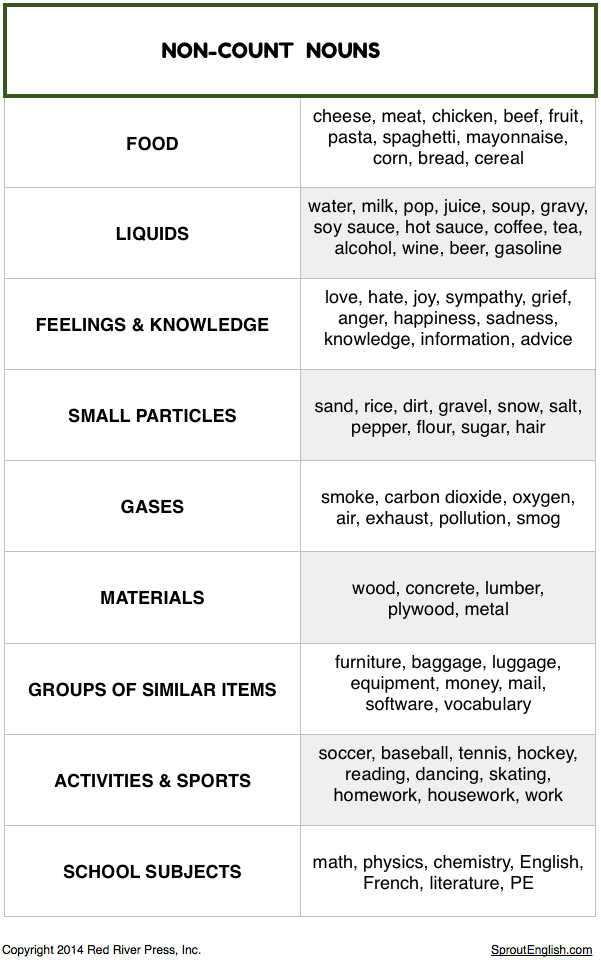
Download Non-Count Noun Chart PDF
3. PRACTICE:
Try the following printable exercises for some practice with count and non-count nouns.
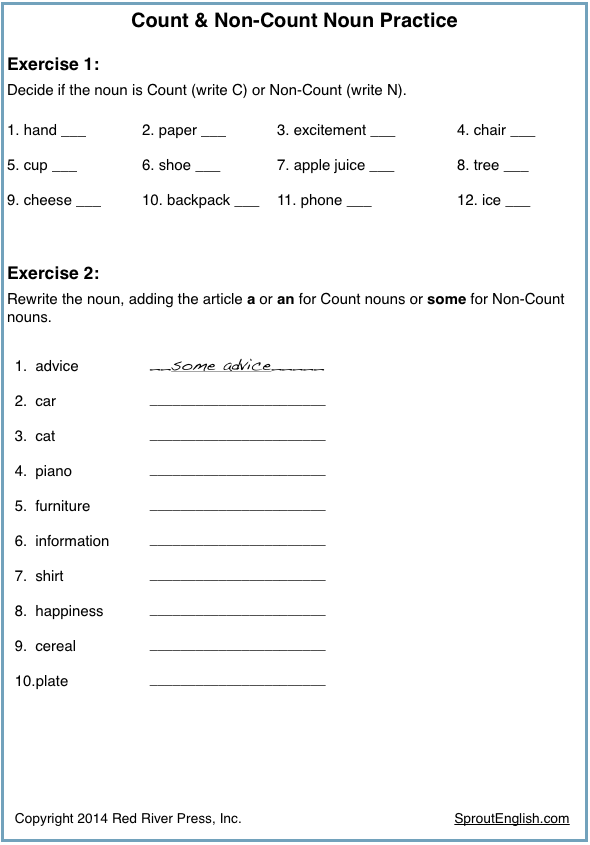
Download Non-Count Noun Exercises PDF
Answer Key:
Exercise 1: 1. hand C 2. paper N 3. excitement N 4. chair C 5. cup C 6. shoe C 7. apple juice N 8. tree C 9. cheese N 10. backpack C 11. phone C 12. ice N
Exercise 2: 1. some advice 2. a car 3. a cat 4. a piano 5. some furniture 6. some information 7. a shirt 8. some happiness 9. some cereal 10. a plate


[...] Count & Non-Count Nouns | Sprout English
Thanks for all your suggestion, they are very helpful.
I’m happy to hear that, Stefania! Thanks.
I’m loving your website. You think of everything Have a wonderful day!
Thank you for your kind comment, Tracy!
Giving home task is really appreciable
You’re welcome! I know it can be hard for teachers to find enough homework.