
Independence Day is coming up on July 4, and Sprout English has a NEW Word Bank lesson for you to try. If you’re looking for another Independence Day idea, here is a fun listening and handwriting activity.
Many teachers no longer teach cursive in the classroom. Even if kids don’t learn cursive, they should still learn how to sign their own names. Introduce your students to the expression “Sign your John Hancock” with this short listening activity.
Listening Practice
John Hancock lived in Boston, Massachusetts, in the 1700s. He was a rich American businessman. John Hancock was also a member of the US government. In 1776, John Hancock was the first person to sign a very important document. This document was called the Declaration of Independence. John Hancock’s signature was bigger and bolder than all of the other signatures on that document. In fact, his writing was so big that Americans started using his name to mean the word “signature”. When someone says, “I need your John Hancock” or “Please sign your John Hancock,” they mean “Give me your signature.” Your signature is your handwritten name. Do you know how to write your own signature?
Handwriting Practice
Next, have your students practice writing their own signatures. Print out one copy of this PDF for each student.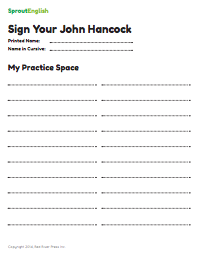 Handwrite each student’s first and last name in the space provided before you hand out the worksheets. Then have your students practice writing their own name in the practice space (page 1) using your model as a guide. (Sprout English also has cursive worksheets in the Phonics Cafe.)
Independent Writers
Finally, have students walk around the class asking for autographs from their classmates. Students will enjoy having their own autograph keepsake (page 2).
Can I have your John Hancock, please?
May I have your signature, please?
Sign your name here, please.
Can I get your autograph?
Need more Independence Day resources? Try these writing/pronunciation tips: Numbers in Dates: Should We Write July 4, July 4th, or the Fourth of July?


Here’s a related article that came up in my newsfeed today: http://theconversation.com/handwritings-relevance-in-a-digital-world-25443
Thanks for sharing, Tara! Great article. This was a good point: “While typing on a digital device might be efficient, timely and convenient, even adults acknowledge that we learn and recall better what we write down on paper by hand. “