For a bedtime story last night, my son chose a book that he had picked out at the library: The Natural History Museum Book of Animal Records by Mark Carwardine. We were proud to find out that we knew quite a few animal records already, such as the longest migration for a mammal (gray whale), or the most dangerous shark to humans (bull shark). We laughed ourselves silly in the Birds section, where we found records for the worst walker (hummingbird), the most bossy (kea), and even the strangest nesting material (mockingbirds in Ecuador snatch hair from passing tourists).
If your students are practicing superlatives with this week’s lesson plan, why not create your own Animal Records book? Include the most amazing facts you can find in the library or on the Internet.
Make Your Own Animal Records Book
After you’ve used Sprout English’s NEW lesson plan on Superlatives and reviewed important Spelling Rules for Superlative Adjectives, tell your students that you are going to work together to make a book of Animal Records. You could make one book as a class (e.g., Animals), or assign separate animal classifications to small groups of students, such as Mammals, Birds, and Fish.
Next, work together to come up with a list of superlatives that you want to include in each book. If you’re doing more than one kind of book (e.g., one group is doing Birds and one group is doing Fish), the superlatives your students will use may be different.
Here are some examples:
- most venomous
- longest living
- fastest
- longest teeth
- longest tail
- highest jump
- oddest looking
- most transparent
- longest migration
- best night vision
- heaviest
- largest appetite
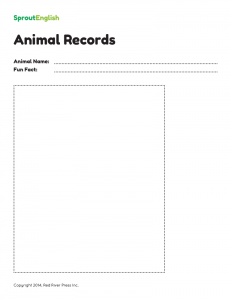
Assign one research fact and page to each student. Your students can do their research in the library or on the Internet with the help of a parent. You could also take an Animal Records book out of the library and have kids take turns choosing the fact that they find most interesting. Each student will make a page that includes a sentence about the animal record and a drawing of the animal. You can print this template and hand it out to your students, or design your own. Some students may want to create more than one page. Staple all of the pages together or place them in a booklet or folder.
Show and Share
If you make one book as a class, allow your students to take turns bringing it home. You could include a page at the back for parents to leave a comment about the most interesting fact they learned.
Animals are the best!
Related:
Find this week’s Spotlight lesson in our Grammar School – Basic Grammar Structures section.


Purchase a subscription to access all our Young Learner resources at a low price today!

