This week in the Spotlight, we’re featuring a printable from Sprout English’s Games Room. Swimming with Sharks is an adaptation of the traditional game of Snakes and Ladders. Tanya offers some ideas for using this game to review grammar and vocabulary.
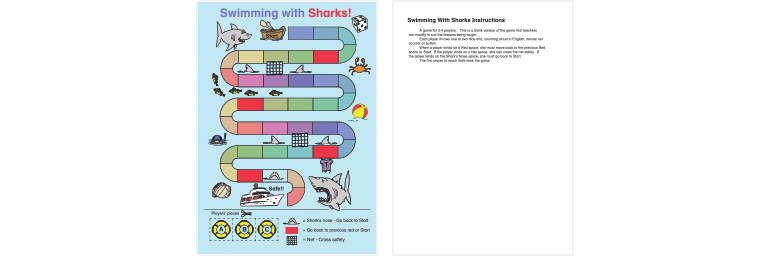
You can print out the game for a few small groups, or set it up in a play center. Here are a few more ideas for playing and adapting this game.
Play It As Is
Without adapting anything, your kids can have fun swimming with the sharks. They’ll practice numbers by moving from square to square. Remind students that a net allows the swimmer to cross safely. If you don’t print your board game in color, have the kids color four of the squares in red.
Learn New Words
How many English words do your students know from the game board? Here are the words they will find. Ask them to label the game board before they play. You could also challenge them to place a checkmark beside pictures that have a /sh/ sound.
- shark ✓
- fin
- scuba diver
- life preserver
- die (explain the singular vs. the plural “dice”)
- net
- paddle boat
- T-shirt ✓
- shell ✓
- fish ✓
- crab
- beach ball
Add a Color by Number (or Pattern) Activity
Print the game board in black and white and have your students color in the squares based on your instructions. Use color names that are new or that need practicing. (Make sure all of the colors you choose are available in the classroom.) There are 38 squares on the game board. Here is one example:
- Squares 1–5 – Color mauve
- Squares 6–10 – Color turquoise
- Squares 11–16 – Color peach
- Squares 17–22 – Color red
- Squares 23–28 – Color beige
- Squares 29–34 – Color gray
- Squares 35–38 – Color navy blue
Or if you’re working on patterning, have students add stripes, polka dots, diamonds, etc. You could also have students choose their own sequence, such as three of one color or pattern, followed by two of a different color or pattern. They could also add to the legend for some of the colors or patterns (similar to the red square in the game).
Add Pronunciation Practice
When playing this game, your students will naturally practice pronouncing /sh/ and /s/. Add the following words on the board squares. Students have to pronounce a word properly before moving from that square.
- ship
- shell
- shark
- T-shirt
- safe
- sea
- swim
- stop
- scuba diver
Here are some other words/pictures you could add:
- shorts
- sugar (a tricky one because of the spelling—add a sign that says Sugar Beach)
- sand
- south (add a compass pointing south)
- sun
- shopping bag
Alternatively, place words on the board that have minimal pairs, and ask students to think of one before they take another turn.
Make Up Some Rules
Kids love making up rules. Rules are useful for practicing commands. Remind your students to use the base form of the verb when writing a rule. Here are some examples.
- Go back to the start.
- Miss your turn.
- Move back one.
- Move ahead two.
- Eat a rotten fish. Miss two turns.
- Stop to look at shells. Miss two turns.
Add Some Doodles and Detours
Encourage the kids to add more drawings to the board game. These might be other /s/ or /sh/ words or words that are related to the sea. They will also have fun adding detours (more shark’s noses or traps) that make it more difficult to get to the Finish. While the kids are playing, ask the students what they added.
Teacher: What did you add to your game?
Student: I added two fishing hooks.
Teacher: What happens if I land on a fishing hook?
Student: You get caught! You have to go back to the start.
Add Math Questions
Are your students learning simple equations, such as addition and subtraction? Add some math questions to the board. Make sure that students answer the questions in English. Pre-teach the necessary math words, such as “plus,” “minus,” and “equals.” If a student answers incorrectly (or not in English), they miss a turn, or go back one square.
Compare the Board Games and Players
Compare the board games that your students adapted. Whose game was most difficult to win? Whose game was easy? Compare the players, too. Who came in first, second, and third? Who got eaten by a shark? Who used the safety net?
Related
This Pinterest board has some fantastic ideas for adapting board games for young learners. If your young learners have tiny hands and find it difficult to hold cards, be sure to check out these ideas! You may also want to try getting your kids to make their own dice.
See also:
Active Games for Young Learners
Daily Routines Game
Animal Battle: An ESL Card Game
Pronunciation Game: A Plural Party
Guess the Travel Memory Game
Alphabet Name Game

