Do your students get confused by all of the different quantifiers in English? There are many ways to indicate the amount of a noun, including using words like many, much, a lot, lots, some, several, a few, a couple, etc. The common term some is used when we want to indicate an amount that is not too much and not too little. But can we use some in all types of English sentences, including positive statements, negative statements, and questions? Sometimes we need to use any instead, and that can be a source of confusion for English language learners! Teach your students the differences using the tips below, and get them to try the practice exercise below.
Some

In English, we usually use some in positive sentences. Some is used with both count (countable) and non-count (uncountable) nouns.
Examples:
- They asked for some help with their project.
- She wants some jewelry for her birthday.
- I have some friends who you might know.
- My coworker has some extra tickets for the concert tonight.
Any
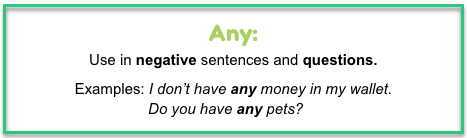
In English, we usually use any in negative sentences and questions. Any can be used with both count and non-count nouns.
Examples:
- He doesn’t want to do any homework this weekend.
- My best friend doesn’t have any siblings.
- Do you have any credit cards in your wallet?
- Will he pay any price for that car?
Exception
There are almost always exceptions to English grammar rules! One common exception to the some/any rule is that we usually use some in questions that are offers and requests.
Examples:
- Do you want some coffee? (offer)
- Can I have some coffee, please? (request)
- Can I offer you some strawberries for dessert? (offer)
- Can I trouble you for some more strawberries? (request)
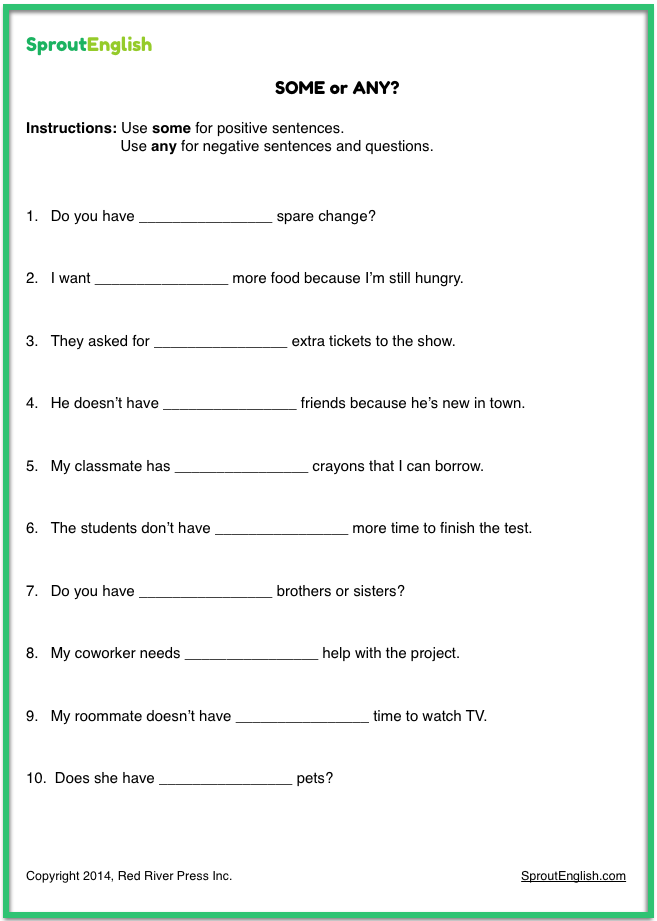
Practice
Answers
1. any 2. some 3. some 4. any 5. some 6. any 7. any 8. some 9. any 10. any
Activity
Our Spotlight lesson this week was about Pizza. A good way to practice some and any would be to tie them into the pizza lesson! Brainstorm popular pizza toppings with your class. Put students into pairs or small groups and tell them they must create five pizzas with two toppings on each one. One of the pizzas can have crazy toppings (e.g., sand and starfish). Tell students to ask their classmates about their pizzas. They must use any in the questions and some or any in the responses. See if they can figure out the ingredients used! To wrap up, have students share their crazy pizza toppings with the class.
Examples:
A: Does your pizza have any pineapple on it?
B: Yes, it has some pineapple. OR No, it doesn’t have any pineapple.
A: Does your pizza have any mushrooms on it?
B: Yes, it has some mushrooms. OR No, it doesn’t have any mushrooms.

