Odd One Out: 5 Silly Activities for Very Young English Learners

Young kids often giggle when they see things that don’t seem quite right! Get your youngest English learners giggling (and learning) with these silly Odd One Out games and activities.

Dizzy Doodlers

You will need: Whiteboard markers or chalk and a board

1. Think of a category or theme that you have been working on with your students, such as “shapes” or “animals”. Don’t tell the kids the theme.
2. Invite four students up to the board. (your first set of doodlers)
3. Choose three related words from your category (e.g., monkey, hippo, bear) and one unrelated word (e.g., can of soup). Assign all of the students at the board one of the words you chose. If they don’t know the word in English, you can translate it.
4. Before the students start drawing, spin them around once or twice (to get them a bit off balance).
5. Give the kids a short amount of time to create their drawing.
6. When the drawings are finished, ask the class this question:

Who’s the Dizzy Doodler?
In other words, which student drew the picture that doesn’t belong in this collection? Have your students identify each drawing as well as the category or collection the drawings belong in. Which category or collection would the odd picture belong in? (more…)


Sports Crossword

There are many ways to review vocabulary, and using an activity such as a crossword puzzle is always a hit with students! Our Spotlight lesson this week is our Sports Crossword.

If you log in to Sprout English and type “sports” in the search bar, you’ll find over 50 lessons, flashcards, and activities about sports to do with your young learners. Try a lesson on Sports from our Word Bank, and follow it up with our Sports Crossword, Sports Jumble, Sports Word Search, or 3 Sports Mazes for fun-filled vocabulary review! (more…)

3 FREE Activities for St. Patrick’s Day


Are you looking for some fun St. Patrick’s Day activities to hold at your green party on Monday? You are having a green party, aren’t you? At a green party, the students dress in green, eat green food, and drink green beverages. You can serve green milk and cookies, or green cupcakes and juice. You’ll also need some fun St. Patrick’s Day activities! Before you try these ones, be sure to introduce your young learners to our St. Patrick’s Day poster of idioms. Make sure that they understand the idiomatic meanings before you introduce these activities. (These activities play on the “literal” meaning of the words, as the poster does. It will help them remember the expressions.)

FREE Activities for St. Patrick’s Day

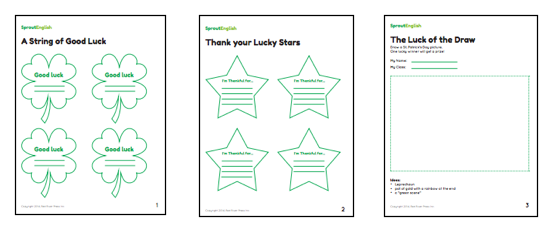
Print out this handout to eliminate prep work. This is a party after all! Photocopy as many copies as you need! You’ll also need string, scissors, clothes pegs (or paperclips), and coloring utensils (lots of green).
(more…)

9 Ways to Use Cards & Flashcards in Class

Teaching from a textbook all day can be tedious for both students and teachers. Breaking up the time with interactive warm-ups, filler, and wrap-ups makes the lesson engaging and fun! One way to do this is with cards—both flashcards and playing cards. Using cards in the classroom also lets you sneak in some learning while your students think you’re just playing a game. Young learners, especially, respond well to games, and if the games are educational, there’s no reason to limit their use! Games can involve speaking, vocabulary, grammar, etc., but today I’ll focus on ways to use vocabulary cards.

Card & Flashcard Games:

Try the following games with Sprout’s cards in the Card Games section of the Games Room. We have image/word card sets on animals, clothes, farm animals, fish and reptiles, fruit, jobs, prepositions, verbs, and adjectives! (more…)

Animal Card Games

Flashcards and card games can be used in a variety of ways in an English classroom. They make vocabulary learning fun, and are great as a warm-up, filler, or wrap-up to a lesson. With over 48 words and pictures, our Animal Cards are sure to engage your young learners!

Sprout English’s 48 animals cards include all the animals you’d expect and then some! Students review common animals such as dog, elephant, and hippo while learning about more exotic animals like armadillo, baboon, and hyena. These Games Room cards make learning new vocabulary fun and easy. Be sure to print them out double-sided so that the pictures are on one side and the words are on the other. (more…)

Teaching English with Stuffed Animals and Puppets

This week’s featured Sprout English lesson plan is all about hippos! I was excited to see the Did You Know lesson featured, because I wrote it when my young daughter was obsessed with hippos. She had a large collection of stuffed hippo pals, and while writing this lesson I learned that these animals aren’t as cute as they look. Hippos are such interesting creatures! Did you know that hippos wear sunscreen?

Stuffed animals and puppets can make fun and educational guest appearances in the young learner classroom. Invite your students to bring in a favorite stuffed animal to class. You may even want to ask the kids to leave a stuffed friend in a cubby at school. Create a sign up sheet, and have students write down the type of animal they plan to bring in. If a number of students plan on bringing a stuffed bear, try to encourage them to bring in a toy that is more unique, like a hippo! (more…)

Daily Routines Game – Reviewing the Simple Present Tense

Have you played the In My Suitcase memory game with your students? This is the game where you sit in a circle and the first student says,

“We are going on a trip, and in our suitcase I will bring…”

After the first student names one thing, the next student repeats the sentence, names his/her classmate’s item, and adds an additional item to the suitcase. For example:

“We are going on a trip, and in our suitcase we will bring a map, and a cell phone.”

As the game continues, the packing list gets bigger and harder to remember.

The suitcase game is excellent for practising nouns, but you can play a similar game to practice using the simple present tense to describe daily routines. Write the following starter sentences (time markers) on the board: (more…)

Active Games for Young Language Learners

One of the best things I’ve seen implemented at my children’s elementary school is called DPA. This stands for “daily physical activity”, and it takes place in the classroom or hallway at a set time each day. During the brain break, students and teachers move away from their desks and dance to a song that some of the older kids have choreographed. Not only does DPA amuse the students and give them something to look forward to, it boosts the energy of the teachers and unites the school.

Besides dancing, there are tons of games for keeping young kids active during the school day. Here are some ideas and adaptations to try with your young English learners:

Drip, Drip, Drop – This is a variation of Duck, Duck, Goose, and is played outdoors on a warm day. The teacher brings out a big bucket of water and a sponge. The students sit in a circle. The teacher gets the sponge quite wet, so that it drips a bit. One student is chosen to stand up and walk on the outside of the circle. She says “Drip, Drip, Drip…” as she drips a bit of water on each classmate’s head. Instead of tapping one person’s head and shouting “Goose!” she shouts “Drop!” and squeezes the sponge out on her victim. The victim with the wet hair chases the sponge holder around the circle, trying to reach the empty spot in the circle first. Try some other variations, such as (more…)