There are a lot of prepositions in English and many of them have multiple functions. Prepositions were usually at the top of my students’ troublesome grammar lists! Breaking prepositions up into categories (such as place and time) often helps students learn and remember them more easily. Our Spotlight lesson this week was our Word Bank lesson on Prepositions of Place, so I decided to create some worksheets to practice two of the most common prepositions: IN and ON. I divided the worksheets into two pages—the first is a basic exercise on places, and the second is one on transportation (because in my experience, students get quite confused by vehicles—in a car vs. on a bus, for example).
Author Archives: Tanya Trusler

Prepositions

So many prepositions, so little time! English language learners tend to struggle with prepositions because of the wide variety of meanings and uses. Breaking prepositions up into types can help! The focus this week is on prepositions of place in our Word Bank lesson on Prepositions.
This lesson contains eight beautifully illustrated pages that include a colorful picture dictionary, matchup, word choice, word search, word scramble, and spelling bee. Discussion questions at the end allow your students to practice prepositions in context! (more…)
Clothing & Shopping Activities Using Flashcards

Learning new vocabulary can be a struggle for English language learners. Teachers can make it easier and more interesting with flashcards! This week our Spotlight was on Clothes in the Card Games section of our Games Room, and we wanted to give teachers some suggestions on how to use these flashcards in class. If you have your own favorite flashcard activity, please write it in the comments section below—we’d love to hear it!
Activities with Cards/Flashcards for Clothes & Shopping:
1. Dress Up: Put students into pairs and have them draw two stick figures (a man and woman or a boy and girl). Give each student a set of flashcards and tell them to place the clothing pictures on the stick figures to “dress them up.” Students should discuss their choices using the clothing vocabulary. You can repeat this activity using different themes such as formal, casual, business, etc. Ask each pair to come up with a theme to share with the class.
2. Silly Dress Up: (more…)
Clothing Flashcards

Clothes and shopping are popular topics in most classrooms. With 32 picture cards and 32 word cards, our Clothing Cards make vocabulary learning fun!
Use these cards as a warm-up, filler, or wrap-up to a lesson on clothing or shopping, or use them anytime for a fun, educational activity. These Games Room cards make learning new vocabulary fun and easy. Try printing them out double-sided so that the pictures are on one side and the words are on the other. (more…)
Pronunciation of Past Tense Endings
Many languages have a one-to-one spelling-pronunciation relationship, but the English language has no such thing! This is why English pronunciation is difficult for learners to master. On top of the 26 vowel sounds and many tricky consonant sounds such as “th”, students need to learn the pronunciation of endings that change according to the last sound of the word. For example, the past tense ending -ed can be pronounced as /t/, /d/, or /ɪd/ depending on the last letter of the verb. Luckily there are rules for such cases!
Today’s blog post was inspired by this week’s Spotlight lesson, Juan and Sofia – Simple Past Reading, which has an exercise on the spelling rules for adding -ed (the past tense ending of regular verbs). I thought it would be helpful to blog about the different ways of pronouncing the -ed ending. Note that I use the International Phonetic Alphabet (IPA) in this post. Play the audio examples at the end of this article for pronunciation practice for your students or children.
1. Pronounce the -ed ending as /t/ following voiceless consonants. (more…)
Juan and Sofia – Simple Past Reading

Are your students or children ready for a review of the basic verb tenses? This week’s Spotlight lesson, Juan and Sofia – Simple Past Reading, includes the simple present, present progressive, and simple past tenses, and will engage your kids with a hilarious story and fun, educational activities!
This lesson includes a short reading, comprehension questions, sentence puzzles, a crossword, and a group discussion activity to review the simple present, present progressive, and simple past. There is also a helpful spelling review on forming the past tense of regular verbs.
All of the readings in our Library section have a digital component, so teachers and parents can choose how to present the reading and comprehension questions—either on paper or online!
Other simple past resources: (more…)
Pronunciation Practice: L & R
This week’s Spotlight lesson is our Phonics lesson: M to R, which gives low-level learners printing and pronunciation practice. The letter “R” inspired me to write this post on perhaps the trickiest bit of pronunciation in English: the /r/ sound. I’ve had students from all over the world struggle to pronounce /r/ as we do in English! Minimal pairs with /l/ and /r/ can be especially difficult for English language learners, so I thought I’d include some practice in my blog post today.
Tongue position:
What position does the tongue need to be in to form the /l/ and /r/ sounds in English? In most languages, including English, the /l/ sound is produced with the tip of the tongue against the back side of the front teeth. The tongue “flaps” or flicks outward when making the /l/ sound. Most students have no problem making the /l/ sound.
The /r/ sound, in most languages other than English, is made with the tip of the tongue near the front teeth (similar to the /l/ sound in English). The tongue often flaps or trills in this position. The English /r/, however, calls for the tongue to be much farther back in the mouth. The tongue stays flat and doesn’t move up and down. (See the pronunciation tips section below for more /r/ pronunciation info to give to students.) (more…)
Phonics Lesson: M to R
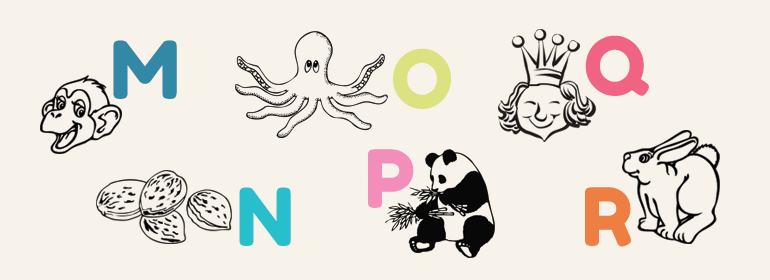
Sprout’s Phonics Cafe section offers many lessons to help improve low-level English learners’ printing, writing, spelling, and pronunciation. This section starts with the alphabet and works up to letter combinations and words that are difficult to pronounce and spell. This week’s Spotlight lesson is on the letters M to R. Your students will love the colorful illustrations and engaging activities!
This 20-page phonics lesson can be broken up and done over several days so that your learners get as much practice as they need. It starts off with simple printing exercises for the uppercase and lowercase letters M through R. The colorful images also give learners a chance to practice their pronunciation. (more…)
How to Introduce Yourself in English
This week’s Spotlight lesson is our new Simple Present – Be lesson, where language learners can get a lot of practice introducing themselves. Introductions are one of the first things students need to learn to do in a new language. Feeling confident and comfortable doing so can go a long way to making language learning an enjoyable experience.
Like most (if not all) languages, there are a variety of ways to introduce ourselves in English, and we don’t want our students freezing up in the real world if they hear a variation from what they practiced in class. That’s why dialogues that show possible variations (such as the free, printable dialogue below) are great—students can see other ways of saying the target phrase and repeat the basic conversation several times without getting bored.
For listening practice and as a model before the students try it themselves, play the audio clip at the bottom of this post or ask for two volunteers. (more…)
Simple Present – Be

We are excited to present our NEW lower-level, simple present lesson on the verb “to be”! We’ve come up with a brand new template for this lesson, and we’d love your feedback! Please let us know what you think (what was useful, what was missing, etc.) in the Comments section below or through the Contact page on our website.
Introducing yourself in English is one of the first things students should learn. Our Simple Present – Be lesson in the Basic Grammar Structures section of the Grammar School gives students plenty of chances to practice this! (more…)
