Easter Colors: An Eggcellent Easter Activity

Do you use Pinterest for inspiration when you’re looking for crafts to do in the classroom? Pinterest is full of holiday craft ideas, and with a little creativity, you can easily find ideas that can be combined with language learning.

Last weekend I went hunting on Pinterest to find ideas on painting eggs with nail polish. One of my daughter’s favorite games right now is “Name the Nail Polish”. We gather all of our bottles of nail polish and put them in her glittery treasure box. She pulls the bottles out one by one and we take turns coming up with fun names for the colors. Twinkle Twilight…Party Perfect…Salmon Suede…Confetti… Sometimes we play this game out loud together, and other times we write the words down and compare the color names. We’ve played this game with up to four people (boys included), and it works best when we have lots of different colors (at Auntie K’s). Sometimes we even vote on the color names to see which ones we like best. When we’re done, we look at the bottom of the bottles to see what the real names are.

I was delighted that my “nail polish Easter eggs” search on Pinterest brought up so many ideas for coloring eggs. There were ideas for painting real eggs as well as plastic eggs. I was skeptical that nail polish and water would work well on plastic eggs, but was excited to find out that it actually worked when I tested it out!

This particular idea, “You’ve Been Egged” would make a great classroom activity or weekend project. You could “egg” another classroom at your school, or invite your students to “egg a neighbor” over the Easter weekend. Here is a handout you can give your students if you want them to do this activity at home. *

You will need: (more…)

Guess the Travel Memory: Word Cloud Game

“I dislike feeling at home when I am abroad.” ~ George Bernard Shaw

This week’s Spotlight lesson plan is all about the Great Pyramid of Giza. Have your students traveled to interesting places? Do they enjoy learning about mysteries?

One way to have fun with mysteries is to have your students make word clouds about their vacations and travels. I play a word cloud guessing game with my online learners every time I go on a trip. We do this activity together on my teaching blog, but it can also be done in pairs or small groups in class with a printout or handmade word cloud. The best way to play this game is to demonstrate once (as the teacher) with your own travel memories. Your students will love getting to know you better by learning about a trip you took.

1. Brainstorm

Brainstorm about ten interesting memories from a trip you’ve taken. Look through your photographs for ideas.

2. Make a List

Write a word or two to represent each memory. It can be a noun, verb, adjective, or short phrase. (If you have pictures of these memories, bring them in to class!) I just returned from a trip to New York City. Here are my words. (more…)

Digital Tools for ELs: Summary of TESOL 14 Session

The TESOL 2014 Convention in Portland was a great place for teachers to learn new ideas, feel inspired, and network. TESOL always has plenty of great sessions to choose from, and on March 28, I attended a valuable session called “Digital Tools for ELs: Constructing Language and Content Knowledge” (EL = English Learner). Since many teachers couldn’t make the convention, I decided to share what I learned at this session on our blog because I know many teachers are interested in using technology in the classroom.

This session was put on by some lovely ladies from the University of Alabama and Etowah County Schools. The ladies, including DeAnna Ruhl, Amanda Foss, and Holly Hubbard, gave an excellent presentation where they explained the pros and cons of various apps, which I’ll recap for you here.

  • Students can upload slides/photos and narrate each slide
Pros:
  • Easy to comment on and easy to share
  • Can be embedded (more…)

April Fools’ Day or April Fool’s Day?

Don’t be an April fool—figure out the rules before talking about this holiday in class!

On April 1, people in many countries will play practical jokes on each other. These can range from taping a “Kick me” sign on someone’s back, to switching the sugar and salt, to the BBC airing a fake news story about a spaghetti tree. Mashable compiled a list of Google’s past April Fools’ jokes that would be fun to show and discuss in class. If you plan on discussing April Fools’ Day in your class, it’s a good idea to get the capitalization and punctuation rules straight first!

April Fools’ Day or April Fool’s Day?

It depends on where you live (or which spelling system you’re using to teach).

According to Merriam-Webster’s Collegiate Dictionary (11th edition), the correct spelling of this holiday includes using the plural form “Fools” and capitalizing each word. This dictionary uses the apostrophe after the “s” to show the possessive form of the plural noun. If you are teaching students in the US, you should use April Fools’ Day. (more…)

Sprout English Is Heading to the TESOL Convention!

Hello, Portland!

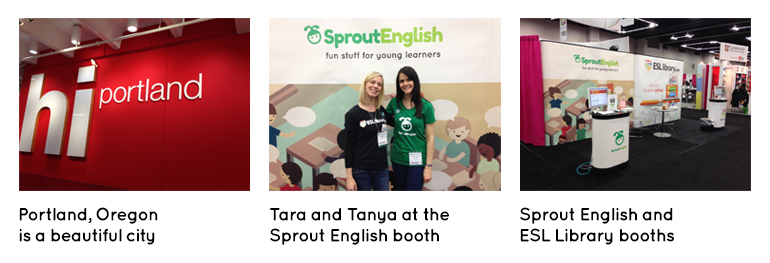
It’s time once again for the annual TESOL International Convention and English Language Expo. This year, the Sprout English team is heading to Portland, Oregon from March 26–29, and we’re really looking forward to it!

It will be Sprout’s first year at the convention! Last year, the team was there at the ESL Library booth, and this year, our booths will be side by side, numbers 338 and 340. Our team is coming from Winnipeg (Ben, president), Toronto (Tara, writer), and Vancouver (me - Tanya, editor). We can’t wait to meet our subscribers and other teachers and publishers in the ELT field, so please come by and say hi! There will also be daily prize giveaways and special subscription deals for attendees. (more…)

Where Is Sprout? Games for Practicing Prepositions of Place

“Come out, come out, wherever you are!”

Do your students enjoy playing hide-and-go-seek? Do you know how to make this game educational? Hide-and-go-seek is the perfect game for practicing prepositions of place. If you haven’t already introduced these little words and phrases to your English learners, check out Tanya’s useful post. It’s full of teaching tips on prepositions of place (and directions), including this FREE handy handout.

1. Warm-Up

After you’ve introduced prepositions of place to your students, you can review them by showing this funny series of visuals. Simply ask this question: Where is the child hiding? Go over some of the different prepositions from the pictures.

under the bucket, behind the curtain, in the cupboard, behind the towel, beside the crib…

(more…)

Prepositions of Place & Giving Directions

Our Spotlight lesson this week, New Town, is all about maps, prepositions of place, and giving directions. In my experience, textbooks often present a map and expect students to generate directions without much guidance. My students would often make many little mistakes, such as forgetting the article “the” before the building names and forgetting secondary prepositions (such as “to the left of”). I found that reviewing prepositions of place first was helpful, followed by providing students with a lot of examples of directions. With the help of our talented designer Robyn, I created a worksheet of common prepositions and directions that your students can use for easy reference. After reviewing these lists, give our Spotlight lesson a try!

(more…)

3 FREE Activities for St. Patrick’s Day


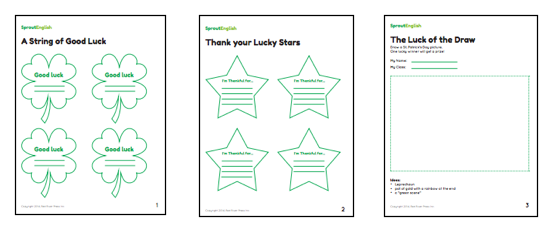
Are you looking for some fun St. Patrick’s Day activities to hold at your green party on Monday? You are having a green party, aren’t you? At a green party, the students dress in green, eat green food, and drink green beverages. You can serve green milk and cookies, or green cupcakes and juice. You’ll also need some fun St. Patrick’s Day activities! Before you try these ones, be sure to introduce your young learners to our St. Patrick’s Day poster of idioms. Make sure that they understand the idiomatic meanings before you introduce these activities. (These activities play on the “literal” meaning of the words, as the poster does. It will help them remember the expressions.)

FREE Activities for St. Patrick’s Day

Print out this handout to eliminate prep work. This is a party after all! Photocopy as many copies as you need! You’ll also need string, scissors, clothes pegs (or paperclips), and coloring utensils (lots of green).
(more…)

Lucky Idioms – Poster & Activities

For each petal on the shamrock
This brings a wish your way—
Good health, good luck, and happiness
For today and every day.
—Author Unknown

With St. Patrick’s Day just around the corner (March 17), it’s a great time to learn these idioms about luck!

Idioms appear in many places in English—in movies, on TV, in books, and in everyday conversation. Students usually enjoy learning idioms because they’re fun, but have trouble remembering them because they’re not literal. Using visuals such as this poster helps students remember idioms, especially when the visuals contain clever “tricks” (our designer has worked some literal clues into this poster). (more…)