This week’s Spotlight features a lesson plan from our Conversation Station. This section is full of dialogues for English language learners to read, listen to, and practice.
It is useful for learners to practice conversations using ready-made dialogues, and it’s also useful to use authentic dialogues once in while. You can invite speakers into your classroom, or find authentic dialogues on podcasts and videos. We had our own dialogue at Red River Press this week, and we thought students and teachers might find a few different uses for it. Be sure to download the useful document that we are talking about!
What follows is a conversation I had with Red River Press’s editor, Tanya Trusler. You can play this listening file for your class, and see if they can understand the gist.
Possible Follow-up Questions
- Who are the speakers, and what are their roles?
- What is the conversation mainly about?
- How does the conversation begin and end?
- Who would find “the document” handy, and why?
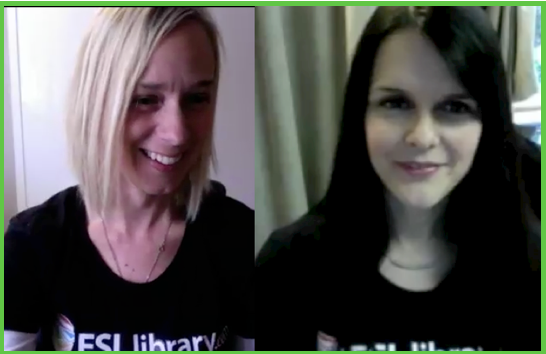
Transcript
Tara:Hi Tanya.
Tanya: Hi Tara.
Tara: Thanks for coming to chat with us today! Um, I just want to introduce Tanya to anyone who doesn’t know her. For those of you who don’t know Tanya, she is the editor of ESL-Library, as well as the director of Sprout English. And she does editing for Red River Press, which develops both of these sites, as well as, um, apps for English learners. And, so, this means that Tanya has a lot of text to edit. She edits our blogs, our newsletters, all of our marketing material, and our lesson plans. And, um, one thing that she blogged about recently that I thought was really interesting was our style guide. So I wanted to talk to Tanya today about the style guide. Can you tell us a little about how the style guide helps you do your job?
Tanya: Yeah, sure. Um, basically every editor needs a style guide for consistency. So, um, especially on a site like Red River Press with a lot of material–we um, need to keep everything consistent across all our lessons. So I need to make decisions about things like when to use the serial comma, and when to capitalize words and titles, um, American vs. British spelling, things like that. So, once I decide something, I record it on a style guide so that I can refer to it, and remember all of my decisions, and keep everything consistent.
Tara: Oh, that’s great! And we get a lot of, um, feedback from teachers about our lesson plans, and how they like how they’re formatted consistently. It’s really important when you’re, uh, teaching English learners.
Tanya: So important. Yeah.
Tara: Yeah. And we just recently finished our American Presidents section, which has 43 ready-made lesson plans. Uh, referring to the style guide was really helpful with this section. Can you, um, talk a little bit about that.
Tanya: Sure, yeah. This section is a good example of why a style guide is so important because it was a big section with so many lessons. Um, so I had to look up a lot of things I was unfamiliar with, actually. I use a reference guide called the Chicago Manual of Style. It’s a really common reference guide for editors. And, uh, I had to look up how to capitalize different wars, and acts, and treaties. A lot of American political stuff that I wasn’t familiar with being a Canadian. So, for example, one of the the first things I had to look up was when to capitalize the word “president”. So I learned that you capitalize it when it comes before the name, like President Obama would have a capital P. But not in other situations where it’s not, uh, preceding the name. So, for example if you said Obama is the president you wouldn’t capitalize the p there. So…
Tara: Oh great. Interesting.
Tanya: I’ve learned a lot.
Tara: It’s been really helpful to have that on the blog as well because we can go back and forth and ask each other questions and respond, so…
Tanya: Definitely. I think it’s helpful for all teachers and students, too. I mean even as native speakers, we’re not always taught these style rules in school, so…
Tara: And how did you decide on the Chicago Manual of Style for, uh, Red River Press.
Tanya: Yeah, well that was an easy decision. Because when I was studying to become an editor, um, all of my professors were telling me that that kind of the editor’s main tool. It’s the most common reference guide that editors use. And it is American. A lot of our audience is American, so it’s helpful for our market to use an American style guide. Um, there are others, though. There’s for example the AP – the American Press or the CP – the Canadian Press. And, unfortunately, they don’t always agree. For example, the AP and CP don’t use the serial comma, but the Chicago recommends it. I mean, some things are just style decisions and you just have to pick away and stick to it, as long as you’re consistent, that’s the main thing. So…
Tara: Right. And it’s so helpful for me as a writer. And I know for you as an editor as well that we have one thing that we can always refer to. Why is it helpful for our subscribers, do you think? We’ve decided to publish it online so that our subscribers can have access it.
Tanya: Um there’s just a lot of things that, like I said aren’t really taught in schools. And also, just things that, um, for example song titles. Maybe people aren’t familiar, like… How should I write a song title? Should I use quotation marks? Should I use italics? What should I do? So we have different sections, for example, if you look under titles you’ll see how to, um, you know, format the titles for movies, books, and songs, and things like that. Um, song titles should be enclosed in double quotation marks, and album names should be italicized. That’s just the common style choices that most people use, but not all of us are familiar with that, so, lots of useful stuff on there.
Tara: Awesome. It’s so handy. I can’t believe that we used to work without it, so I’m really, really thankful that we have it.
Tanya: Yeah. Me too. I use it all the time. It’s good, yeah.
Tara: Well thank you so much for taking the time to come and chat with me today about this. We have a busy month ahead. I know you’re editing our new lesson section, Everyday Idioms 3, which I’m really excited about. Awesome. And I’m going to be seeing you in a few weeks when we, uh, head to TESOL 14 in Portland. So I can’t wait to see you again.
Tanya: Yeah. That’s going to be fun. I can’t wait.
Tara: Alright. Thanks again. We’ll see you later.
Tanya: Okay. Thanks, Tara. Bye.
Download Red River Press’s Style Guide, and find other useful information here.
Watch the video footage of this interview on our YouTube channel.


Purchase a subscription to access all our Young Learner resources. Only $7 a month.

