3 Fun Ways to Use Irregular Verb Cards

Our Spotlight lesson this week was our Simple Past grammar lesson. When it comes to learning the simple past, students rejoice at the lack of subject-verb conjugation. Unlike the simple present, where students must add an -s to the end of third person singular subjects, the simple past has only one form for all subjects. There’s more good news when English language learners realize they must only add -ed to the end of the base verb to form the simple past for regular verbs.

However, irregular verbs can pose a problem for learners. How do they memorize all the various endings and changes that irregular past tense verbs take? Repetition is key, and if teachers can make it fun, students are more likely to want to practice! (more…)

#ELT Ideas: Games, Activities, and Tips for Teaching English to Young Learners

Sprout English has been growing for over a year now!

As a materials writer who contributes to various Red River Press publications, including Sprout English (previously English Avenue) and ESL Library, I was excited about the opportunity to blog with the Sprout team. I have been blogging in the field of ELT for many years both personally and professionally. Here are a few reasons why Sprout English has been my favorite place to blog so far!

  • It’s beautiful! The clean design and gorgeous illustrations make it a pleasure to blog here. I love looking at the finished product. Thanks, Robyn!
  • It’s organized! Sprout’s editor Tanya Trusler has the blog team working on a handy, theme- and grammar-based schedule. Each post connects with a featured lesson in our Spotlight section.
  • It’s useful! Many of our posts offer free, professionally designed worksheets to go with our suggested activities. The blog allows teachers to get a feel for the quality-based materials that Sprout English offers to subscribers. (more…)

Odd One Out: 5 Silly Activities for Very Young English Learners

Young kids often giggle when they see things that don’t seem quite right! Get your youngest English learners giggling (and learning) with these silly Odd One Out games and activities.

Dizzy Doodlers

You will need: Whiteboard markers or chalk and a board

1. Think of a category or theme that you have been working on with your students, such as “shapes” or “animals”. Don’t tell the kids the theme.
2. Invite four students up to the board. (your first set of doodlers)
3. Choose three related words from your category (e.g., monkey, hippo, bear) and one unrelated word (e.g., can of soup). Assign all of the students at the board one of the words you chose. If they don’t know the word in English, you can translate it.
4. Before the students start drawing, spin them around once or twice (to get them a bit off balance).
5. Give the kids a short amount of time to create their drawing.
6. When the drawings are finished, ask the class this question:

Who’s the Dizzy Doodler?
In other words, which student drew the picture that doesn’t belong in this collection? Have your students identify each drawing as well as the category or collection the drawings belong in. Which category or collection would the odd picture belong in? (more…)

End-of-Year ESL Activity: Obstacle Courses


My daughter, who isn’t really into sports, recently told me that she only likes gym class when they get to play sports that their teacher invents, such as “benchball”. She was surprised to hear that basketball was created by a gym teacher, and that it used to be played with peach baskets. My son loves anything to do with sports, but right now he’s obsessed with a running race challenge he invented at school. “You get to make up a new name for yourself every day, and every day is a new season. You have to win five races in a row before you’re crowned the champion!”

The idea of inventing anything (and making up the rules) is something kids get really excited about. This is why so many kids love obstacle courses! The end of the school year is a great time to have play days with obstacle courses. You can celebrate all of the obstacles that your students have overcome! Obstacle courses are useful for language learners because they can review vocabulary related to sports equipment and actions. They can also practice giving, writing, and listening to instructions.

Whether you are a teacher or a parent, here is an Obstacle Course Activity to try with your young English learners :

Warm-Up Questions

First, teach the word “obstacle course” and consider how it relates to language learning:
How is learning a language like going through an obstacle course?

  • It’s mentally challenging.
  • You have to figure out how it works.
  • You can’t move too quickly.

Next, talk about some of the specific obstacles language learners face:
What are the difficult parts (obstacles) in learning a language?

3 FREE Activities for St. Patrick’s Day


Are you looking for some fun St. Patrick’s Day activities to hold at your green party on Monday? You are having a green party, aren’t you? At a green party, the students dress in green, eat green food, and drink green beverages. You can serve green milk and cookies, or green cupcakes and juice. You’ll also need some fun St. Patrick’s Day activities! Before you try these ones, be sure to introduce your young learners to our St. Patrick’s Day poster of idioms. Make sure that they understand the idiomatic meanings before you introduce these activities. (These activities play on the “literal” meaning of the words, as the poster does. It will help them remember the expressions.)

FREE Activities for St. Patrick’s Day

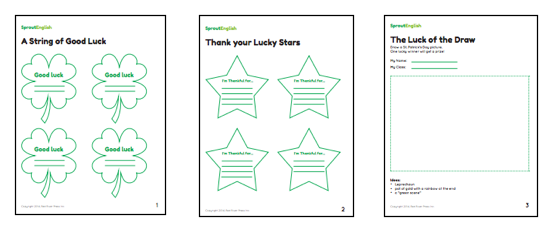
Print out this handout to eliminate prep work. This is a party after all! Photocopy as many copies as you need! You’ll also need string, scissors, clothes pegs (or paperclips), and coloring utensils (lots of green).
(more…)

Lucky Idioms – Poster & Activities

For each petal on the shamrock
This brings a wish your way—
Good health, good luck, and happiness
For today and every day.
—Author Unknown

With St. Patrick’s Day just around the corner (March 17), it’s a great time to learn these idioms about luck!

Idioms appear in many places in English—in movies, on TV, in books, and in everyday conversation. Students usually enjoy learning idioms because they’re fun, but have trouble remembering them because they’re not literal. Using visuals such as this poster helps students remember idioms, especially when the visuals contain clever “tricks” (our designer has worked some literal clues into this poster). (more…)

Teaching English with Stuffed Animals and Puppets

This week’s featured Sprout English lesson plan is all about hippos! I was excited to see the Did You Know lesson featured, because I wrote it when my young daughter was obsessed with hippos. She had a large collection of stuffed hippo pals, and while writing this lesson I learned that these animals aren’t as cute as they look. Hippos are such interesting creatures! Did you know that hippos wear sunscreen?

Stuffed animals and puppets can make fun and educational guest appearances in the young learner classroom. Invite your students to bring in a favorite stuffed animal to class. You may even want to ask the kids to leave a stuffed friend in a cubby at school. Create a sign up sheet, and have students write down the type of animal they plan to bring in. If a number of students plan on bringing a stuffed bear, try to encourage them to bring in a toy that is more unique, like a hippo! (more…)

Active Games for Young Language Learners

One of the best things I’ve seen implemented at my children’s elementary school is called DPA. This stands for “daily physical activity”, and it takes place in the classroom or hallway at a set time each day. During the brain break, students and teachers move away from their desks and dance to a song that some of the older kids have choreographed. Not only does DPA amuse the students and give them something to look forward to, it boosts the energy of the teachers and unites the school.

Besides dancing, there are tons of games for keeping young kids active during the school day. Here are some ideas and adaptations to try with your young English learners:

Drip, Drip, Drop – This is a variation of Duck, Duck, Goose, and is played outdoors on a warm day. The teacher brings out a big bucket of water and a sponge. The students sit in a circle. The teacher gets the sponge quite wet, so that it drips a bit. One student is chosen to stand up and walk on the outside of the circle. She says “Drip, Drip, Drip…” as she drips a bit of water on each classmate’s head. Instead of tapping one person’s head and shouting “Goose!” she shouts “Drop!” and squeezes the sponge out on her victim. The victim with the wet hair chases the sponge holder around the circle, trying to reach the empty spot in the circle first. Try some other variations, such as (more…)

Things to Do with a Map

It’s Map Time: Using a Map with Young Learners

I was excited to see a tweet today from an ESL teacher in Iowa (@sturgeonesl) who is going to try using Sprout English materials with her young ELLs.

I immediately visited Ms. Libby’s blog and read a post about how she’s setting up her very first classroom. In her post, there are pictures of bookshelves, a calendar, and a map. Ms. Libby wrote:

“My roommate let me borrow this large map for my room. While right now I’m not planning on really doing anything with the map, I think it’s a good thing to showcase in an ELL room. And who knows, maybe it will come in handy later this year.” (more…)