At Sprout English, we are interested in seeing the ELT community grow! We like sharing articles related to education and passing along relevant information. We recently came across a website with an interesting concept: Kid Toc, where kids teach kids English. (more…)
Author Archives: Tanya Trusler
Question Intonation – Yes/No & Wh-Questions
For many learners of another language, speaking is the scariest skill. After all, speaking is when you have to produce language in the least amount of time, and the listeners are there to form instant opinions of your ability—at least, that’s what it feels like to many! But never fear, practice makes perfect! As teachers, we can also help our students feel more confident about their speaking ability by teaching them pronunciation and intonation rules. What better place to start than with question intonation?
Most languages have only one type of question intonation: rising. English, on the other hand, has two types of question intonation: rising and falling. Fortunately, the question intonation patterns of English follow set rules—it depends if the question is a yes/no question (rising) or wh-question (falling). 
The easiest way for students to pick up the intonation of a language is by modelling fluent speakers. Play the audio clips below for both types of questions, or read the questions out loud yourself, and have your students repeat the questions back.
I. YES/NO QUESTIONS:
In English, yes/no questions start with an auxiliary verb (do, be, have, or a modal such as can, should, will, etc.).
Intonation for Yes/No questions is rising. This means your voice will go up at the end of the question.
Turn Off the TV – Dialogue

Turn Off the TV, in the Simple Past Dialogues 2 category of the Conversation Station, is Sprout English’s lesson of the week.
This one-page dialogue is the perfect way to review the simple present, present progressive, and simple past. All three tenses are used naturally in this conversation between a father and his daughter. The topic of a parent wanting a child to stop watching TV and go study is something kids can definitely relate to! (more…)
5 Activities for Teaching & Reviewing Vocabulary
What do your students think of when they hear the word “vocabulary”? Do they think of boring repetition and memorization? Do they think it’s the most difficult part of learning English? If so, it’s time to change their attitudes! Learning vocabulary can be fun when teachers present it in interesting ways. It’s also a lot easier to remember new words with frequent repetition, so try reviewing vocab using a variety of activities to keep students engaged. The activities suggested below are always a big hit with my students!
Teaching Vocabulary
1. Vocab on the Board:
Introduce new vocabulary with this competitive activity that is sure to grab and keep the attention of your young learners. This is a game you can play with the whole class. (more…)
Thanksgiving – Vocabulary Lesson

Updated for 2015. Please use this link to find out about this lesson: http://blog.sproutenglish.com/thanksgiving-vocabulary-lesson-3/
Teaching the Simple Past
The simple past is a verb tense that students are introduced to fairly early on. It usually follows the simple present and the present progressive. It’s pretty hard to have a conversation in English without using the past tense. From sentences like “What did you do last weekend?” to “Did you watch that show last night?”, the simple past is essential to speaking as well as reading, writing, and listening. Try presenting the simple past to your young learners using the tried-and-true method below, which includes explaining the form and use, listing the time markers, giving examples, and using interesting lessons and fun activities to practice this common verb tense. There’s also a handy list of common irregular verbs at the end!
FORM:

Eva – Simple Past Reading

This week at Sprout English our focus is on the simple past. The lesson of the week is Eva from the Simple Past Stories section in the Library. This four-page lesson includes a reading and discussion questions that are available in both print and digital form. There are also two fun activities to practice past verbs, a word maze, and a crossword puzzle. Finally, students can practice writing and speaking by using past verbs to talk about clothes and fashion. (more…)
American Vs. British Spelling
How many words are there in the English language? Global Language Monitor estimated that number was 1,013,913 on January 1, 2012. Most dictionaries list the number of current words at around 150,000. For example, the Oxford English Dictionary has entries for 171,476 words in current use.
English spelling: The number of words notwithstanding, spelling in English is a lot more difficult than in other languages. Many languages have a limited number of sounds; for instance, a, e, i, o, and u only have one pronunciation each in many languages. English, however, has 26 vowel sounds alone! Outside of vowel sounds, many English words have spelling that doesn’t match the pronunciation, with words such as knight, cough, phone, etc. Also, there aren’t many rules for English spelling, and the few rules we do have are often broken (consider the i before e, except after c rule: chief, but their).
American vs. British spelling: To top it all off, there are also spelling variations that differ by region of the world. The most prevalent difference is American spelling vs. the spelling of other English-speaking countries, which primarily follow British spelling practices. These differences can be frustrating for teachers and students (not to mention business owners, government workers, and many others.). At my old school in Canada, we used textbooks from both the US and the UK, so students were exposed to both American and British spelling on a regular basis. Figuring out how to present these spelling differences to students was a challenge. (more…)
Astronauts
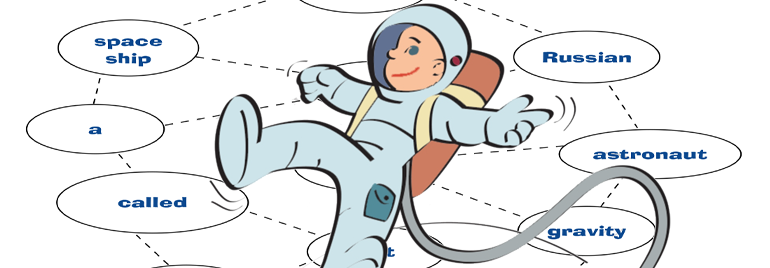
This week, Sprout English’s featured lesson is Astronauts from the Interesting Jobs section in the Discovery Center. This five-page lesson includes discussion questions, vocabulary exercises (including a word scramble), a short reading full of interesting facts, comprehension questions, and a word maze. There is even an optional black-and-white title page for your students to color. Your young learners will love learning about the “vomit comet”! (more…)
Introducing Sprout English – Video
Even though Tara Benwell and I work far across the country from each other (she’s in Ontario and I’m in BC), we got to meet up recently when she came out to visit family and friends. We decided to make a video introducing Sprout English, a site full of resources for teaching English to young learners.
